
Most of what is commonly called prayer never fully leaves the activity of the self. This does not mean that it is not prayer. It simply means that prayer is more than rattling off words in the hope of communicating with God. In ordinary prayer the mind reflects, analyzes, feels, and comments, often while sensing that it is speaking to God. Contemplative prayer begins when that activity is recognized and gradually quieted, so that the soul may become more simply present.
At the center of this movement stands pure intention — the orientation of the will that seeks God for His own sake rather than for the satisfaction of the self’s thoughts, feelings, or projects.
The Faculties of the Soul and the Forms of Prayer
The classical tradition understands the soul as working through several faculties: intellect, imagination, memory, emotion, desire, volition (the will), and, more quietly, intuition. St. Augustine was among the first to give these powers a clear spiritual interpretation. Later contemplatives such as St. John of the Cross and St. Teresa of Ávila developed the understanding more carefully, showing how the same faculties can either serve prayer or quietly obstruct it. Different forms of prayer engage these faculties in different ways and sometimes become entangled in them.
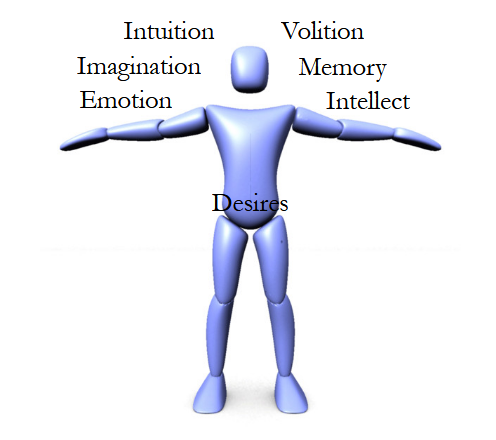
Discursive prayer leans heavily on the intellect, memory, and imagination. One reflects on a passage of Scripture or a spiritual truth, reasons about it, recalls related ideas, forms mental images, and speaks to God through the thoughts that arise. Emotion often joins in, producing feelings of devotion or conviction. This way of praying can be sincere and even necessary at certain stages. Yet it easily remains within the circle of the self. The intellect generates the content, the memory supplies associations, the imagination elaborates, and the emotions respond — all while the deeper volition may still be mixed. What feels like conversation with God can become the soul talking to itself through its own faculties.
Vocal and liturgical prayer engages the same powers when the words are accompanied by ongoing mental commentary or emotional self-observation. Affective prayer stirs the emotions and desires, which can open the heart, but can also keep attention fixed on the self’s inner states rather than on God.
Contemplative prayer asks for a different relationship to these faculties. The intellect is not destroyed, but it is quieted. The imagination and memory are not constantly fed. Emotion and desire are neither suppressed nor indulged as the main focus. Volition — the will — is gradually purified so that it seeks less its own satisfaction and more the simple doing of God’s will. In this quieter atmosphere, intuition (the more direct, non-conceptual sensing of God’s presence) has room to emerge.
Pure intention is especially tied to volition. It is the will’s growing preference for God over the self’s preferred thoughts, feelings, and outcomes. When intention becomes simpler, the other faculties begin to fall into a more ordered place. They no longer dominate the prayer; they serve it, or rest.
Right Intention and Simple Intention in Prayer
Thomas Merton — writing on the contemplative life — distinguished between a merely right intention and a simple intention. A right intention seeks to please God and to do His will, yet still regards the work and the self as somewhat separate. One offers the action while remaining aware of the action and of oneself as the one performing it. There is still a subtle looking toward results or spiritual progress.
A simple intention moves further. One begins to act in God rather than only for God. Attention rests less on the thing being done and more on the One in whom it is done. The atmosphere of the act itself becomes prayerful. This is the beginning of purity of intention: the willingness to let the self’s commentary diminish so that prayer and action rest more directly in God.
In the deeper contemplative life this purity is tested by the refusal to seek special experiences, insights, or consolations. One does what is to be done without constant evaluation. The faculties are allowed to quiet rather than being kept busy producing spiritual content.
Pure Intention in the Midst of Struggle
Discursive prayer, for all its limitations, is not always a dead end. There are times when a person turns to God with real desperation — reasoning, pleading, reviewing thoughts, wrestling with emotions — precisely because the longing for God is intense. The very activity of the intellect and the turmoil of the emotions can feel like barriers, restricting access to the quieter depths of contemplative prayer. Yet even here, pure intention can carry the soul further than the disordered faculties alone would allow.
When the will is genuinely oriented toward God, the struggle itself can become a form of prayer. The person may feel only distraction, dryness, or the painful sense of being shut out. Still, the underlying intention — the desire to be united with God rather than merely to feel spiritual or to master a method — gives the effort a different weight. Merton observed this paradox clearly:
“The true contemplative suffers from the fact that he thinks he is without desire of God, and that very suffering bears witness to his desire. The suffering itself is often the work of infused love. Therefore the Christian contemplative, even when he fears that his prayer is hopelessly sterile and distracted, contradicts his own fears by the very intensity of the anguish with which he longs for God” (Thomas Merton, The Inner Experience: Notes on Contemplation).
In other words, the anguish of seeming failure can itself testify to a deeper intention that the intellect and emotions cannot fully grasp or control. Pure intention does not magically silence the faculties, but it can orient the whole disordered effort toward God in such a way that grace is not blocked.
This must be understood carefully. Merton is not suggesting that the struggle with intellect, emotion, and will is unimportant, or that one may safely neglect the ordering of the faculties. The purification of those powers remains part of the contemplative path. What he points to is a mercy: even while the faculties remain restless and imperfect, a sincere intention directed toward God can still open a way. The difference is not made by the perfection of the method, but by the orientation of the will beneath the method.
This same dynamic appears again and again in the language of art and music, where the soul’s struggle is portrayed as a storm that cannot be calmed by insight or feeling alone. One contemporary expression is the song “Praise You in This Storm” by Casting Crowns. The lyrics give voice to a person who has prayed for relief that has not come, whose strength is nearly gone, and who can barely hear God’s whisper through the rain. Yet the refrain remains: “I will praise You in this storm.”
The song does not claim that the intellect has sorted everything out, or that the emotions have settled into peace, or that the will feels strong. It simply records the choice to orient the heart toward God while the storm continues. In that sense it illustrates what pure intention can look like amid the disorder of the faculties. Faith here is not a calm mental certainty; it is the will’s refusal to let the turmoil of thought and feeling have the final word. Even though faith itself draws upon will, intuition, and emotion, the decisive movement is the underlying intention that still reaches for God when those faculties are frayed.
The point is not that every moment of desperate, discursive prayer automatically becomes contemplation. It is that a sincere intention directed toward God can remain present and effective even while the inner life feels chaotic. The storm does not have to cease for the orientation of the will to matter.
Scriptural Witness
Scripture consistently locates the decisive issue in the heart and its intention rather than in outward form or mental activity.
“Man looks on the outward appearance, but the Lord looks on the heart” (1 Samuel 16:7). “Create in me a clean heart, O God, and renew a right spirit within me” (Psalm 51:10). Isaiah warns of those who draw near with their mouths while their hearts remain far away (Isaiah 29:13). The command is to love God with the whole heart, soul, and strength (Deuteronomy 6:5).
In the New Testament the same emphasis appears: “Blessed are the pure in heart, for they shall see God” (Matthew 5:8). Prayer is to be hidden, free of self-display (Matthew 6:1–6). “Whatever you do, in word or deed, do everything in the name of the Lord Jesus” (Colossians 3:17). “Whether you eat or drink, or whatever you do, do all to the glory of God” (1 Corinthians 10:31).
These texts do not glorify the restless activity of the intellect or the emotions. They call for an undivided orientation of the will — a purity of intention that orders the other faculties rather than being driven by them.
The Quiet Work of Purification
Pure intention is not a technique the mind perfects. It is the slow re-education of volition so that the soul seeks God more than it seeks its own thoughts about God, its own feelings of closeness, or its own sense of progress. Discursive prayer has its place when it serves this orientation. It becomes a hindrance when it keeps the intellect, imagination, and emotions in constant motion and leaves the will still centered on the self.
The contemplative path asks for a gradual quieting. As the faculties are less frantically engaged, a simpler presence becomes possible. Intention grows purer not by force but by the repeated choice to stop managing the encounter and to remain available to the God who is already present.
This is the heart of contemplative prayer: not the refinement of mental methods, but the purification of the will so that the whole soul — intellect, emotion, desire, memory, imagination, and intuition — may be gathered into a single, quieter orientation toward God.