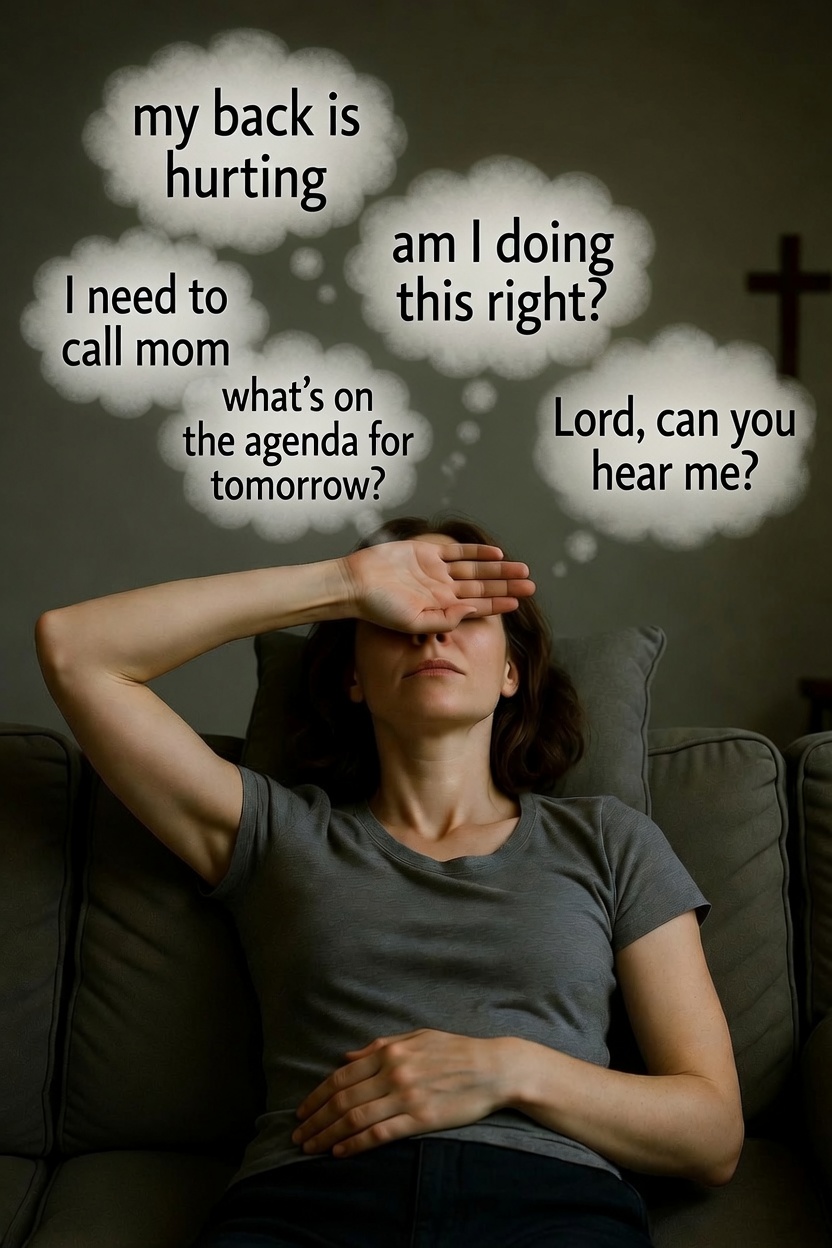
Most discussions of contemplative prayer and Christian meditation begin with the mind. Attention, thoughts, the sacred word, interior silence, and mental distraction receive the majority of focus. The body is usually treated as secondary — something to settle quickly so the mind can get to work, or something that interferes and must be ignored. Let’s briefly examine this.
The Body as Vessel
Contemplative prayer is not a purely mental activity. The discipline demands both body and mind. The body is where attention is directed, where restlessness appears, and where the effects of the practice gradually become embodied as habit. Ignoring or fighting the body can make sustained attention more difficult.
Christian tradition already recognizes the importance of the body. In baptism the body is washed and claimed; Christian Scripture describes that body as a temple of the Holy Spirit (1 Corinthians 6:19). In the Eucharist, the bread and wine are received into the body as a participation in the life of Christ. Both of these practices operate through the body and point to the importance of a contemplative daily practice. The body that has been baptized and that receives the Lord’s Supper is the same body that sits in silence. How that body is handled during prayer affects the quality of attention and the degree of receptivity.
Posture as Structural Support
Many people view meditation posture as either decorative or simply a matter of personal comfort. In reality it is a structural component to meditation practice. An unstable or overly relaxed posture increases the likelihood of drowsiness or constant micro-adjustments. A sloppy or frequently changing posture pulls attention away from the intended focus and prevents the practice from becoming a reliable habit.
A practical working posture is upright and supported: seated in a chair with the back relatively straight but not rigid, feet on the floor, hands resting upon the thighs. The spine should be lengthened enough to allow the breath to move freely, yet relaxed enough that muscular tension does not become a competing stimulus. Lying down is generally counterproductive for most meditation beginners because it makes it easier to drift toward sleep, although for more experienced practitioners, lying down can allow the body to relax more completely during contemplative practice.
Once a workable posture is found, the instruction is simple: leave it alone. Repeated shifting, scratching, or negotiating with minor discomfort keeps the mind occupied with the body instead of free for prayer. The goal is not perfect stillness but sufficient stability so that the body ceases to demand constant management.
Breath as Stabilizing Rhythm
For beginning practice, the breath does not need to be controlled or manipulated into special patterns. Forced or highly measured breathing techniques often create another layer of self-monitoring and pull attention into technique rather than presence. Those approaches belong to a more advanced meditation style discussed later.
The breath is the most immediate bodily process available during meditation. A functional approach is to allow the natural rhythm of the breath to serve as a quiet reference point. When the mind wanders, the simple act of breathing in and out provides a reliable return signal without requiring complex instructions. Over time, the regular cycle of breath can quiet scattered mental activity and support a more settled state of body and mind.
Body Restlessness and Discomfort
Physical restlessness, itching, tension, and mild discomfort are normal. They are not signs of failure. They are information that can help the contemplative understand the body and gradually refine the practice.
Two common unhelpful responses are fighting the sensation by tightening against it, immediately adjusting posture, or even ending the session to eliminate the discomfort. A more effective response is to notice the sensation, register it without dramatic reaction, and return to the intended focus of the prayer. This trains the capacity to remain present when the body generates competing signals. The same capacity is useful outside formal prayer when irritation, fatigue, or physical stress arise in ordinary life.
Just as the mind’s rambling thoughts are met with simple recognition rather than struggle, the body also requires a basic acceptance. Fighting every itch or restless impulse usually increases tension. Learning to listen to the body — distinguishing what it actually needs for stability from what is merely habitual discomfort — allows you to navigate its signals without constantly yielding to them. This listening does not mean abandoning structure. It means building a reliable physical base while remaining flexible enough to adjust when genuine need appears.
Persistent or sharp pain should be addressed by changing position. Ordinary restlessness can be treated as training material. Over time and with perseverance, the intensity and frequency of these disruptions tend to decrease.
Two Approaches, One Practical Aim
The method described above is the approach I recommend for most people. It is simple and sustainable. At the same time, a second, more technical style also appears. People naturally gravitate toward one or the other, and it is for you to try, examine, and decide which method works best for you. Both address the same practical problem: the body must be engaged deliberately if sustained attention is to become possible.
The first style is primarily relational and functional. It begins from the premise that the body has already been claimed in baptism and is continually nourished through the Eucharist as a dwelling place of Christ. The practical work is modest: establish a stable, upright posture that does not itself become a distraction; allow the natural rhythm of the breath to serve as a quiet reference point; and meet ordinary restlessness by noticing it and returning to the intended focus. The criterion of success is reduced interference. The body becomes steady enough that attention can remain oriented toward Christ. This approach emphasizes consent, receptivity, and continuity of presence. It is deliberately simple so that it can be sustained in ordinary life.
The second style is more technical and progressive. It treats the body as an instrument that must be deliberately conditioned. Posture is prescribed with greater precision and is practiced until it can be held without tremor for extended periods. Breath is regulated according to measured, purposeful cycles rather than left entirely natural. Discomfort may be approached progressively, but pain is a signal to stop and adjust. The body is trained so that it can serve as a reliable platform rather than a continual source of interruption. This approach appeals to those who prefer clear method, progressive stages, and observable changes in physical stability and attentional consistency.
In practice, this second style often includes more specific physical disciplines: prescribed postures held for timed periods, deliberate stretching or preparatory exercises, attention to general physical condition, and the regular use of a practice journal to record duration, difficulties, and progress. These elements are trained progressively so that body and attention become increasingly steady and reliable.
These two styles are not rivals. They simply offer different ways to approach the same work. Some people find that the simpler functional approach frees them to remain present without adding another layer of technique. Others find that more systematic training gives them the stability and confidence they need before the relational dimension can open. Both approaches have precedents in older contemplative traditions. The modern task is not to declare one universally superior, but to present both clearly so that individuals can adopt what actually supports their practice.
The reality is that religious language can sometimes become vague or romantic without providing practical guidance for meditation. In the spirit of demystifying contemplative practice, we can say this: the body is neither irrelevant nor the primary object of the work. It is the place where attention is either supported or continually interrupted. Whether a person leans toward the relational-functional style or the technical-progressive style, the shared aim remains the same — a body that no longer constantly pulls attention away from the intended orientation. Ancient methods recognized this. Bringing them into the present simply means stating the options without unnecessary mystique or unnecessary confusion.