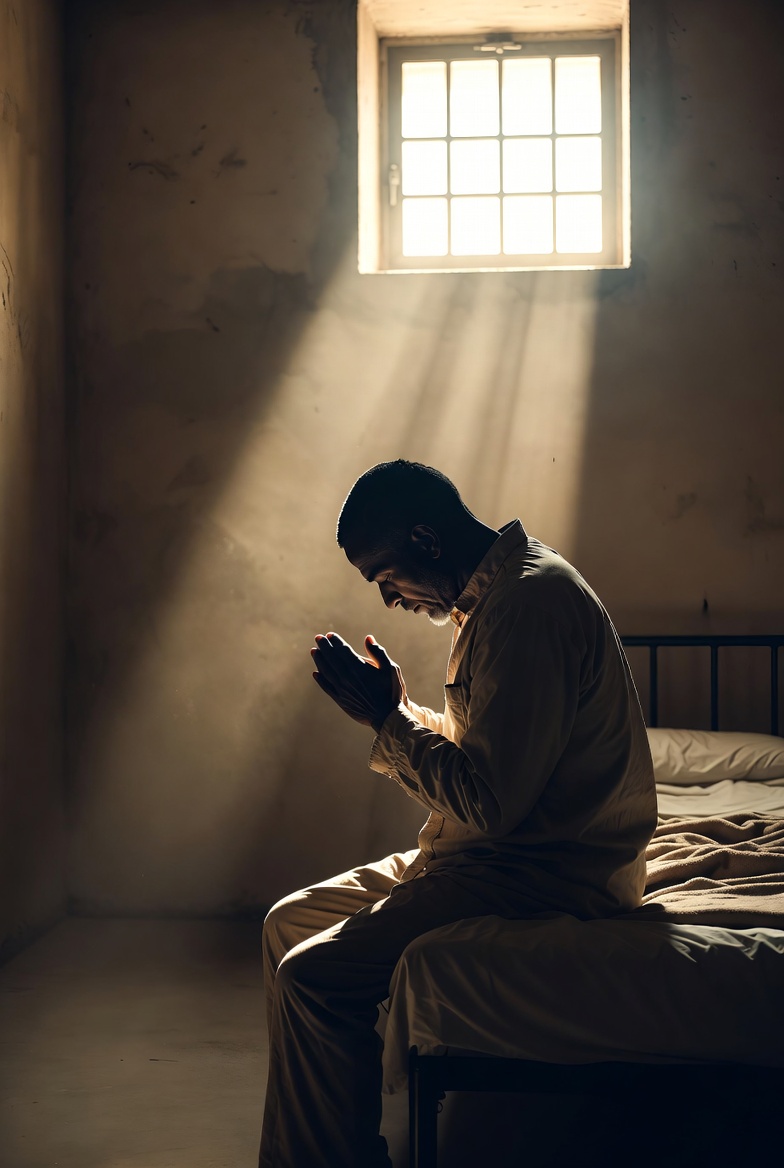
Many people today feel a deep hunger for stillness, presence, and a living relationship with God. Some turn to mindfulness or modern consciousness practices and later discover that Christianity has been cultivating the same interior attention for nearly two thousand years. The path is ancient, continuous, and still open to all.
The direct experience of Christ, and the way that experience unfolds in a human life, has not changed across the centuries. What has changed are the symbol-sets people have used to understand and speak about the inner path and the relationship itself.
From the earliest centuries, Christian contemplation took a simple and concrete form. The Desert Fathers and Mothers withdrew into solitude not to escape the world, but to watch the heart, quiet the thoughts, and rest in the presence of God. Their central practice was often the Jesus Prayer—the quiet, repeated calling on the name of Jesus. They called this state hesychia, stillness. Their language was stark and unadorned, yet the encounter they pointed to is the same one still offered today.
As the tradition moved through the Middle Ages, the great mystics continued the same journey with richer language of love and longing. Bernard of Clairvaux, the unknown author of The Cloud of Unknowing, Julian of Norwich, John of the Cross, and Teresa of Ávila spoke of darkness, desire, and transforming union. At the same time, an older philosophical current that had already entered Christianity through writers such as Dionysius the Areopagite gave them a way to describe the ascent of the mind and the illumination of the heart. This Neoplatonic inheritance helped Christian writers speak of participation in the divine life without ever leaving the person of Christ behind.
A further chapter opened in the Renaissance. Certain Christian scholars encountered the Jewish Kabbalistic tradition and interpreted it through Christian eyes. Figures such as Giovanni Pico della Mirandola and Johannes Reuchlin saw in the Tree of Life and the sefirot a symbolic map that could point toward Christ—the One in whom every divine attribute finds its fulfillment and through whom the soul is restored. This was not an attempt to replace the Gospel with a secret system. It was an effort to use the richest symbolic language available at the time to speak more fully about the mystery of the Incarnation and the inner work of grace. Later Christian writers who drew on alchemical images or Rosicrucian themes continued the same impulse. They spoke of purification, transformation, and the “stone” that is Christ himself, always returning to the living center rather than drifting into pure speculation.
Whether the language is the stark simplicity of the desert, the bridal mysticism of the medieval saints, the symbolic architecture of Christian Kabbalah, or the transformative metaphors of Christian alchemy, the aim remains the same: deeper union with Christ. The outer forms change; the orientation does not.
In our own time, the conversation continues in the language of consciousness studies. Researchers and practitioners describe sustained attention, the quieting of ordinary thought, stillness of mind, and shifts in awareness – all of which contemplatives have long reported. These modern descriptions can be useful. They offer another set of symbols for the same interior path. Yet Christian contemplative practice remains distinct in its orientation: it is not primarily a technique for self-improvement or expanded awareness. It is a relational encounter with the living Christ.
The forms evolve. The experience does not. The same Christ who met the Desert Fathers in the silence of the cell meets us still—directly, personally, and without need of any particular symbol-set. The symbols are only tools that help the intellect understand abstract realities. The relationship is the substance.
If you feel drawn to this path, you do not need special knowledge or elaborate methods. Begin simply. Sit in quiet for a few minutes each day. Breathe slowly. Let the name of Jesus rest in the heart, or read a short Gospel passage slowly and stay with a single phrase. The tradition is not a museum piece. It is a living invitation, still open, still centered on the same Lord.